

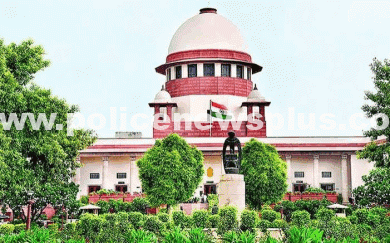
New Delhi: The Supreme Court of India has struck down several stringent conditions imposed by the Andhra Pradesh High Court and a Vijayawada Magistrate on police custody in the high-profile custodial death case of Gade Sai Krishna. The ruling, delivered by Justices Vikram Nath and Sandeep Mehta, balances investigative autonomy with constitutional safeguards for the accused.
The case involves Inspector Suda Suresh Veera Venkata Naga Raju, accused of illegal detention and custodial torture leading to the death of Sai Krishna on May 6, 2026. The Special Investigation Team (SIT) had sought extended custody to trace the victim’s fate, recover evidence, and reconstruct the crime scene. However, earlier orders had confined interrogation to Rajamahendravaram Central Prison and mandated continuous videography of every movement of the accused.
The apex court found such conditions “unworkable” d “unjustified.” It ruled that interrogation need not be restricted to prison premises and may be conducted at SIT’s designated centers in Vijayawada. While retaining safeguards like CCTV coverage and lawyer presence, the Court clarified that the advocate’s role is limited to observation, not continuous participation.
Importantly, the Court rejected the absolute bar on extending custody beyond July 10, noting that Section 187 of the Bharatiya Nagarik Suraksha Sanhita allows police custody in parts up to 15 days. It emphasized that rigid limits would undermine effective investigation.
The judgment underscores that while police must avoid coercion or third-degree methods, investigative agencies cannot be hamstrung by impractical restrictions. The SIT has been directed to conduct a fair, scientific probe, with joint responsibility placed on officers to ensure the accused’s safety.
This ruling is expected to set a precedent for balancing investigative needs with constitutional rights in custodial cases, reaffirming that transparency and accountability must coexist with effective law enforcement.
Our Citizen Reporter – Andaman and Nicobar Islands
Satyajit Naskat